By Jeff Boren
Full transparency—I’ve long been a fan of the HK VP9 series and have owned several over the years. So, when my friend—and HK brand ambassador—Howard Marbury told me a compact variant was on the horizon, I was excited to get my hands on one. As soon as one hit our distributor, I ordered it. A few days later, the new VP9 A1K landed at my FFL.
This isn’t the full review—that will come after the pistol has been thoroughly vetted through class demos, extended range sessions, and the documented drills and courses of fire outlined below. It will see a round count high enough to evaluate its reliability under stress, ensuring a meaningful and comprehensive assessment. But for now, here’s an early look at what HK’s newest compact has to offer.
What is the VP9 A1K?
The A1K trims down HK’s full-size VP9 while retaining the same DNA: modular ergonomics, proven striker-fired performance, and now a factory optics-ready slide comes standard. It ships with two 15-round mags and improves on the forward/rear cocking serrations of the original model. The finger grooves are gone, and the grip is slightly tapered at the tang, which is important and I’ll discuss much more in the full review.
Initial Setup
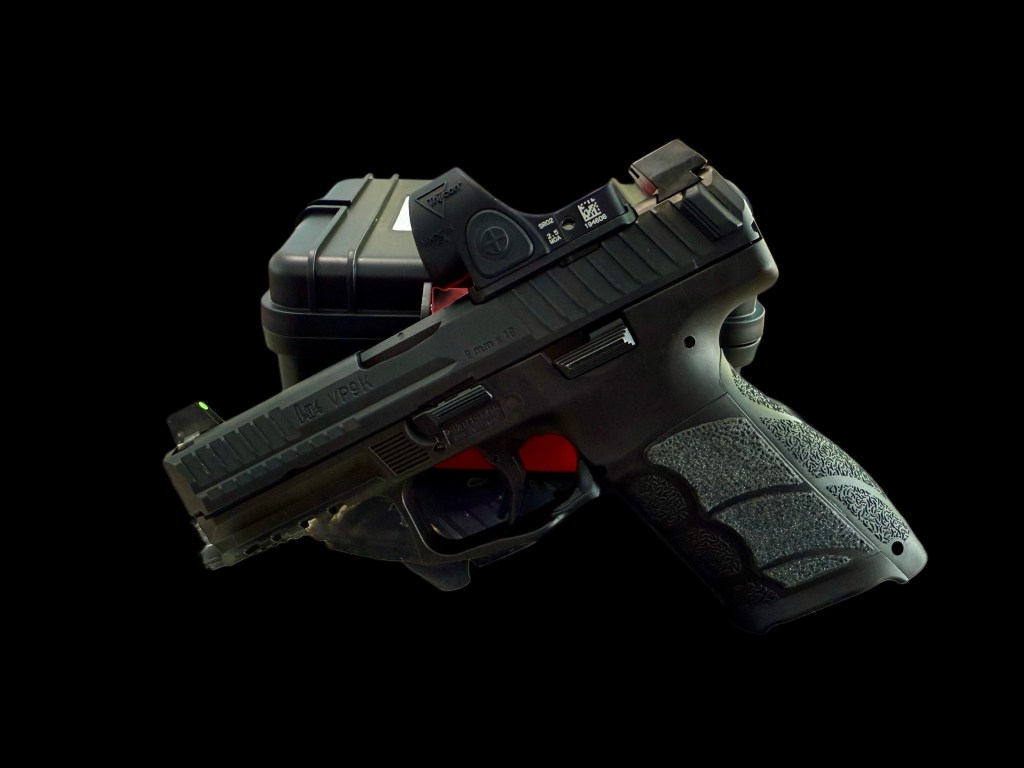
I mounted a Trijicon SRO (2.5 MOA) using the Forward Controls Design OPF-VP9 plate. Backup irons came from the HK Webshop (Tall Sights), and after applying Vibratite and letting everything cure, I hit the range to get started.
HK VP9 A1K with Trijicon SRO and Forward Controls OPF-VP9 plate, ready for zeroing.

First Range Session: Zeroed and Ready
I went with a 25-yard zero for this test phase, aiming for a balance that would serve well across a range of distances. Even though my trigger press wasn’t at its best that day, I was able to establish and confirm a solid zero. The zero was followed by a comprehensive confirmation process of 25 rounds, and the groups held consistently throughout.
The following day, I returned to the range and ran the Rangemaster Instructor Development Qualification Course of Fire, cold. It served as the pistol’s first scored benchmark—and I’m pleased to report I shot a 100, meeting all par times. That early performance, combined with the ease of zeroing, gave me a strong initial sense of the A1K’s potential.
Structured Testing Plan
To ensure my review offers more than just subjective impressions, I’m running the VP9 A1K through a deliberate set of standardized drills and courses of fire. These were selected to measure real performance—technical skill, control, accountability, speed, and consistency—across both high-pressure and precision-focused environments. Here’s what the gun will be put through and why:
- Zero PMO if Applicable / PMO Zero Confirmation (25 Rounds)
Every optic-equipped pistol deserves a confirmed zero. I’m using a 25-yard zero because it provides excellent balance across distances, ensuring minimal point-of-impact deviation from 5 to 25 yards—ideal for defensive work and accuracy validation. - Rangemaster Basic Instructor Development Course of Fire – Shot Cold (50 Rounds)
While not designed to be a cold drill, I chose to shoot the Rangemaster Basic Instructor Development Course of Fire cold to serve as the first scored assessment of this pistol. It’s a well-rounded course that covers nearly everything we should be able to do with a handgun: draw stroke, accuracy, recoil control, reloads, movement, and positional shooting. - Gabe White Technical Skills Tests (34 Rounds)
These drills are designed to measure technical competency in areas like presentation from concealment, speed to first shot, recoil control, and transitions. They’re repeatable, timed, and scored—offering clear performance benchmarks. - Rangemaster Advanced Bullseye Course (30 Rounds)
A deceptively demanding course of fire that focuses on pure marksmanship fundamentals under moderate time constraints. It reveals how well the shooter—and the pistol—can perform in terms of accuracy and control without shortcuts. - Justin Dyal’s Masterpiece: The 5-Yard Roundup (10 Rounds)
Often underestimated, this drill tests both precision and time pressure at close range. It demands strong fundamentals and smooth execution. Dyal’s design highlights how tight the margins are at close distance—especially under stress. - Casino Drill (2x) (42 Rounds)
This fast-paced, cognitive drill introduces decision-making under pressure and forces the shooter to process visual input and shift targets in a variable sequence. It adds meaningful cognitive load, making it an excellent test of how the pistol handles when speed and thought must coexist. - The Test (10 Rounds)
Also known as the “10-10-10” drill—10 rounds, 10 seconds, 10 yards on a B8. This is a go-to standard in the shooting world and provides a good barometer of control and consistency. It’s harder than it looks, especially cold. - FBI 2019 Qualification (50 Rounds)
A law enforcement standard that tests a range of skills: draw, movement, use of cover, reloads, and both one- and two-handed shooting. It’s an excellent simulation of real-world shooting scenarios and demands full command of the gun. - Rangemaster Pistol Master Award Parts 1 & 2 (80 Rounds)
These elite-level tests are among the most difficult standards in the defensive shooting world. Part 1 must be shot cold and passed with a score of 95% or higher before moving on to Part 2, which also requires 95% or better to earn the award. Together, they measure speed, precision, and composure in a way that few standards do.
A full report of how I faired with the A1K on these documented drills and courses of fire will be included in the final review.
Early Impressions
- Recoil Impulse: Incredibly soft for a compact. Honestly, it shoots like a G17.
- Ergonomics: Classic HK—smart contouring and comfort. But I would likely add more aggressive stippling.
- Optic Tracking: The SRO pairs beautifully with the A1K. Smooth transitions and fast follow-ups.
Final Thoughts (For Now)
The HK VP9 A1K is off to a strong start. It’s compact, soft-shooting, and seems every bit as refined as its full-size sibling. But this is just the beginning. With the structured testing plan in place—spanning close- and long-range work, fast-paced drills, precision challenges, and scored qualifications—this pistol will be pushed hard.
Stay tuned for the full review, where I’ll dig deeper into how the A1K performs under pressure, in context, and across time.
 Boren Training Solutions
Leave a comment