Introduction
As with any pistol I review, the primary goal is to give our students—and anyone relying on us for sound information—an honest and unbiased opinion on gear that may be chosen as life-saving equipment. The HK VP9 A1K stood out as a compelling candidate for that scrutiny.
HK’s updated take on the striker-fired compact pistol places the A1K squarely in the same size class as the Glock 19—a benchmark in the concealed carry world. That alone makes it worth a serious look. But beyond size and specs, the A1K represents HK’s attempt to refine an already well-respected platform, and that deserves to be tested, vetted, and verified.
Specifications
- Overall Length: 7.34 inches
- Height: 5.41 inches
- Width: 1.32 inches
- Weight: 25.56 oz (unloaded)
- Barrel Length: 4.09 inches
- Capacity: 15+1 (standard), 17+1 and 20+1 (extended)
- Trigger Pull: 4.5-5.0 lbs (measured average)
- MSRP: $899.99
- Street Price: $829-849 (varies by retailer)
Purpose and Role
The VP9 A1K fits squarely within the concealed carry and duty-sized pistol category. Compact offerings like this—alongside staples like the Glock 19 or the M&P 2.0 Compact—strike a balance that appeals to a wide range of users. They’re small enough to conceal, large enough to shoot well, and fully capable of serving in a uniformed duty role. In many ways, this size class is the “Goldilocks zone” for defensive handguns.
Expectations
Given HK’s reputation, my expectations going into this review were clear: this gun should be ready to go out of the box. HK isn’t known for rushing products to market. In fact, as many enthusiasts know all too well, they tend to take their time—sometimes to a fault. But that patience has typically paid off with quality, well-vetted firearms.
So, when I picked up the VP9 A1K, I expected a pistol that was squared away, dependable, and true to the HK standard. Frankly, I would’ve been disappointed if there were surprises. In fact, I mean it as a compliment when I say I hoped the review would be boring—boring in the sense that the gun just worked, did its job, and delivered exactly what I expected.
Configuration
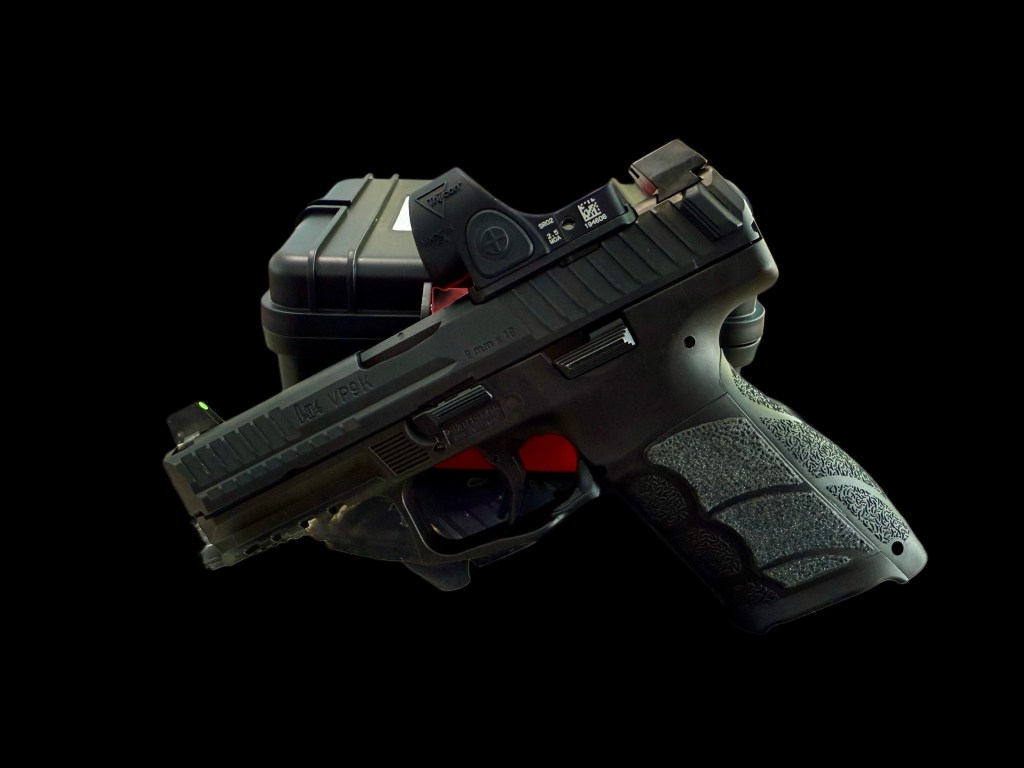
For this review, I mounted a Trijicon SRO using the Forward Controls Design OFP-VP9 RMR plate. In my view, FCD makes the best optic mounting plates on the market—period. Their attention to detail, tight tolerances, and bombproof design are consistent across all the plates they offer. If Forward Controls makes a plate for a system I’m running, it’s my go-to choice every time.
I also replaced the factory sights with HK’s Elevated Sights, which provide a clean lower-third alignment with the SRO’s window. More importantly, they serve as backup iron sights—a term I prefer over “co-witness,” since I do not actually align or verify my dot with the irons during normal operation.
For carry and range use, I turned to a KSG Armory Lexington holster, which I already owned and trusted. KSG’s design and execution are outstanding, and the Lexington served me well throughout the review.
Disassembly and Maintenance
Field stripping the VP9 A1K is straightforward and intuitive. After clearing the weapon, lock the slide back, rotate the takedown lever downward, press the trigger, and ease the slide forward off the frame.
The barrel and recoil spring assembly remove easily for basic cleaning. All internal components are well-finished with no rough machine marks, making cleaning simple. Reassembly is equally straightforward, with components sliding together smoothly without any fussing or alignment challenges.
Access to the striker assembly requires a simple punch tool, but most routine maintenance can be accomplished with basic field stripping. Overall, the VP9 A1K rates highly for ease of maintenance—particularly important for a defensive firearm.
Zeroing and Verification
I zeroed the Trijicon SRO at 25 yards, which is my standard for optics used in this role. The zeroing process was straightforward and efficient. As expected, the VP9 A1K put rounds exactly where I aimed, provided I did my part. It’s a pistol that rewards proper fundamentals.
Once the initial zero was confirmed, I ran the gun through my standard PMO verification process, starting at 3 yards and working back to 25. The A1K passed cleanly, requiring no further adjustment. That consistency out of the gate reinforced my impression that this gun was squared away from the start.
Recoil and Feel
This was one of the characteristics I was especially curious about. In my experience, the full-size VP9 has always had a notably softer recoil impulse—less snappy and more linear than many other pistols in its class. I was interested to see whether shortening the grip for the A1K would change that feel.
It didn’t.
The VP9 A1K shoots more like a full-size pistol than a compact, and its recoil impulse reminds me quite a bit of a Glock 17—smooth, controllable, and easy to track through the cycle. That’s a compliment. Compared to others in this size category—like the Glock 19 or Walther PDP Compact—the A1K feels less sharp in recoil. Not that those guns are unmanageable; they just have a more abrupt impulse. I’d put the A1K right alongside the M&P 2.0 Compact in terms of overall feel—both deliver some of the softest and most controllable recoil in the class.
Personally, I don’t mind the sharper impulse of the Glock. It gives me a very direct sense of feedback and timing. But that’s the key point—subjectivity plays a huge role in how shooters evaluate guns. What feels soft and forgiving to one shooter might feel sluggish to another. The A1K’s recoil impulse is excellent, but the right feel is always personal.
Trigger
One of the most significant updates to the VP9 A1K is the redesigned trigger. HK introduced a nickel Teflon-coated trigger bar, which reduces friction and improves the smoothness and consistency of the pull. They also updated the trigger shoe itself, moving away from the original VP9’s more pronounced “scoop” shape to a flatter profile, offering more flexibility in finger placement.
I liked it. In fact, I feel it’s a noticeable improvement over the original VP9 trigger. Straight out of the box, it’s smooth, consistent, and allows for very accurate shooting. It has just the right amount of take-up and reset for a defensive pistol—enough to feel, but not enough to slow you down unnecessarily.
I expect that with more rounds through the gun, the trigger will likely break in even further and settle into something even better. While I’d love to see HK offer a true flat-faced trigger in future models, as far as curved trigger designs go, this is one of the better ones out there.
Accuracy and Performance
The VP9 A1K performed incredibly well in terms of practical accuracy and control. That said, I’ll be transparent—coming off an extended period running mostly Glocks, particularly my daily Glock 45, it took a moment to recalibrate. The A1K’s recoil impulse is softer and more muted, and at first, I found myself trying to push the trigger pace based on the G45’s sharper return. But this isn’t the G45. Once I re-attuned myself to the A1K’s cycle rate and feel, it was game on.
And once dialed in, the results spoke for themselves. The pistol put rounds exactly where it was pointed, provided I did my job. Accuracy was outstanding—repeatable, predictable, and confidence-inspiring.
It’s also worth mentioning that I shot Tom Givens’ Baseline Assessment Course of Fire clean, cold, with a perfect score—and that was the first time I’ve ever done that with any gun. That kind of performance doesn’t happen with a pistol you’re fighting. It happens with one that works with you.
Competitive Performance
Beyond basic accuracy testing, I ran the VP9 A1K through a couple standardized drills to gauge performance under pressure:
- Bill Drill (7 yards, draw, 6 shots to A-zone):
- Best time: 2.00 seconds flat, all A-zone hits
- Average of five runs: 2.02 seconds
- Tom Givens’ Instructor Qualification:
- Score: 100/100
- This was shot cold, first attempt
The A1K’s performance in these drills places it squarely among the top performers I’ve tested in this size category. The controlled recoil combined with the improved trigger made for exceptionally consistent shooting across varying distances and cadences.
Handling and Controls
If there’s one thing I’d change about the VP9 A1K, it would be the grip texture. I personally like a much more aggressive feel—something with bite. HK opted for a more neutral texture, likely aiming for broader appeal. And to be fair, I tested this gun on hot, humid southern days—90 degrees and dripping—and it never gave me a problem, even bone dry and sweaty.
HK continues to offer some of the best ergonomics in the business, and they’ve expanded the modularity with even more grip panel options, allowing shooters to truly dial in the fit. The A1K comes with nine different grip panels (three backstrap sizes, three side panel sizes) that can be mixed and matched for an optimal fit.
Now to the controls—specifically the European-style paddle magazine release. HK did offer a “B” model with a button release on the original VP9, but as of now, the A1 variants are paddle only. For those who are used to buttons, it may take some adjustment. But for me, it’s second nature.
In fact, the VP9 series is the only gun I can run every control on without breaking my firing grip. I hit the paddle with my trigger finger, move on, and don’t think twice. I automated it years ago and never looked back. Honestly, I find mag changes on the VP9 faster and more intuitive than most other guns I run—even if it does feel just a little un-American.
The slide release is well-positioned and easy to manipulate. The takedown lever is positive and hasn’t shown any tendency to rotate during firing.
Carry Comfort and Concealment
At 25.56 ounces unloaded, the VP9 A1K sits in the middle weight range for its class. It’s slightly heavier than the Glock 19 (23.63 oz) but lighter than the all-steel options in this category. With a proper belt and quality holster, the weight is a non-issue even during all-day carry.
I carried the A1K in appendix position for three consecutive weeks, including during 8+ hour training days and long drives and had no issues carrying or concealing the gun. The slightly rounded edges of the slide made for comfortable carry, with no sharp corners digging in. The frame’s dimensions allow for a solid grip while still maintaining concealability under a t-shirt.
Reliability and Testing
I’ve logged close to 1,000 rounds through the VP9 A1K, using a mix of Blazer Brass 124gr, Magtech 124gr, various 115gr rounds, and my trusted Federal HST 124gr +P defensive ammo.
For this test, I didn’t clean or oil it once during testing. Not at all. It was run bone dry at the end, and it never malfunctioned. Not once. It stayed consistent and reliable from round one to round 1,000.
Ammunition Sensitivity Analysis
As I approached the 1,000-round mark, I also ran a couple hundred rounds of lower-cost 115gr range ammo through the gun. The A1K ate it without hesitation, showing no signs of slowing down—despite the fact that it was still dirty and completely dry since coming out of the bag.
As for drills, I didn’t go easy on it. I ran standard range work, Tom Givens’ Instructor Qualification Course cold (scoring a perfect 100), and multiple Bill Drills, failure drills, etc. from concealment. On the first two timed Bill Drills, I posted a 2.05 and a 2.00 flat, both clean and that was on day one.
By the end of testing, the VP9 A1K just kept running—no excuses, no failures.
Long-Term Durability Assessment
While a 1,000-round test provides good initial data, it’s worth discussing expected longevity. Based on my experience with other HK products and industry reports on the original VP9, I would expect the VP9 A1K to easily handle 20,000+ rounds, if not many more, before requiring any parts replacement.
The nickel Teflon-coated trigger components should provide excellent wear resistance, and the polymer frame has proven durable in previous HK models. The metal parts show excellent machining and finishing, suggesting minimal premature wear concerns.
Based on wear patterns visible at the 1,000-round mark, which are pretty much non-existent, I expect the A1K to be an exceptionally long-lived pistol with proper maintenance.
Pros and Cons Summary
Pros:
- Exceptional reliability (zero malfunctions in 1,000 rounds)
- Excellent accuracy with multiple ammunition types
- Soft, controllable recoil impulse
- Improved trigger over original VP9
- Outstanding ergonomics with multiple grip customization options
- Optics-ready with solid mounting system
- High-quality construction throughout
Cons:
- Higher price point than some competitors ($829-849 street price)
- Paddle magazine release may require adjustment for those used to button releases
- Grip texture could be more aggressive for competition or tactical use
- Magazines are expensive ($49-59 each)
Final Thoughts
The HK VP9 A1K was exactly what I expected it to be: a pistol that’s reliable, robust, and accurate. It doesn’t try to be flashy. It doesn’t claim to revolutionize the class. It just does its job—and does it very well.
It’s optic-ready, supported by a growing market for parts and accessories, and easy to find quality holsters for. Magazines are a little pricey, but they’re out there. Overall, it’s a well-supported platform with premium performance.
I genuinely like this pistol enough to keep using it long-term. It feels at home in my hand and holds its own with the best in the class.
That said, it’s not the cheapest option. Priced in the $800+ range, it sits well above workhorses like the Glock 19 MOS, M&P 2.0 Compact, and Walther PDP Compact. But if you’re someone who appreciates refinement, reliability, and confidence in your gear, the VP9 A1K earns its place.
This is a pistol for the serious carrier—the one who’s willing to spend a little more to get a gun they don’t have to worry about.
 Boren Training Solutions
Leave a comment